
Nobody’s Asking Us
On Redecorating, AI and the Tarp of Democracy

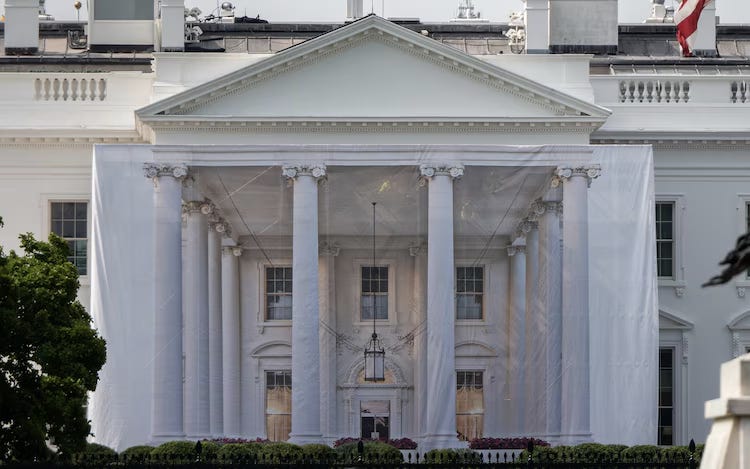
I was working out in the back pasture with my son, Zack, last winter when our neighbor came by to ask permission to build a tool shed against our fence because any construction within three meters of a property line here in Moravia requires a neighbor’s agreement. It was an easy ‘yes,’ but I appreciated the courtesy and I didn’t mind being asked.
I thought about this while looking at pictures of Trump’s Assault on Washington: the fenced-off swamp that used to be the Reflecting Pool, the construction site that used to be the East Wing, the dirt pile that used to be the Ellipse, the pavement that used to be the Rose Garden, the giant tarp-picture over the North Portico showing the White House’s 160 year-old Ionic columns even as, behind it, those same columns are being altered or replaced with more ornate, Corinthian ones.
None of this is Trump’s property. It’s ours.
And nobody asked.
It’s a minor outrage in a sea of bigger ones, true, but representative of a truth so obvious as to be nearly invisible: In this as in so much else, nobody’s asking us.
For billions of people around the globe, that complaint would elicit a tired shrug at best: Of course they’re not asking us – when have they ever? But for an American like myself, raised on the ideal of a government “of the people, by the people, for the people,” the realization that ‘the people’ (at least those who don’t have the good fortune to be billionaires) are largely irrelevant to the conversation being had about their lives, can still elicit some outrage.
It’s our house, not theirs.
It’s our health, not theirs.
It’s our livelihood, our future, not theirs.
And yet, nobody’s asking us before they take it, shape it, change it to their ends. Increasingly, they’re not even pretending to.
The administration cuts protection for hundreds of endangered species, opening up public lands for logging and mining, and nobody asks the people who actually own that land for their permission. What would we have to do with it?
Money doesn’t need to ask. It just does what it wants, and we follow.
Afterwards we pay the bill, in lives and treasure.
Behind the tarp of democracy, we’re being marginalized. No, let me correct that – have been marginalized. On issue after issue, on matters of tremendous significance to us all, on matters that may well decide the course of human history, our history, we have no say. The gears of global capital engage, the flywheels mesh, and the machine moves on without us.
Sure, we have the right to voice our opinion (for now), or to protest peacefully (why not?), or to write our ‘representative’ (ditto), but in this 21st century game of rock, paper, scissors, money beats everything.
The extent to which we’ve been sidelined, even when everything is at stake, can be startling.
I mean ‘everything’ literally.
In May of 2008 I wrote an op-ed for The Los Angeles Times about the Large Hadron Collider, a proton-smashing machine located outside Geneva which was due to be fired up that coming summer. My reason for writing the piece, was that some impressively serious people, among them Nobel laureates in nuclear physics, had crunched the numbers and concluded that there was a non-zero chance that this thing could release particles that would instantly end all life on earth. What did a non-zero chance mean? One scientist, using the methods employed by insurance companies to calculate risk, figured the odds of disaster were roughly equivalent to winning a long-shot lottery.
Let me repeat: These weren’t quacks voicing alarm, and at risk was all life on earth. Everything. My family and yours. All that human beings had ever been and all they ever could be.
And what struck me most was that no one had asked us.
My piece, originally titled, “The Extinction Lottery,” acknowledged that science could never be a democracy, but argued that the need for debate should rise in proportion to risk.
When life on earth was on the line, I suggested, perhaps its conscious members should have some say.
Click this neat photo link to read my op-ed:

I mention this because the threat posed by the AI revolution (not according to this Czech-American novelist who knows nothing about it, but according to those who invented it), is very nearly incalculable. And because the odds of it going wrong are vastly higher than the Hadron Collider’s.
And because, once again, nobody’s asked. It doesn’t even occur. There’s no mechanism by which it could be done, because no one’s thought it might be, you know, useful. Or right.
Which leaves the rest of us asking who, precisely, will benefit from this thing?
The countless communities whose water tables will be drawn down to a dribble - probably not.
The hundreds of millions whose jobs will be taken by workers who don’t eat or sleep - unlikely.
Will accelerating our descent into the “post-literate” world, as The Atlantic calls it, help us politically?
Will destabilizing our senses help us psychologically?
Will outsourcing our humanity to a new machinic phylum, as some call it, make us stronger, kinder, wiser?
Or will it make us slaves?
We know who made this decision. The question is: What gives this vanishingly small group of billionaires and their investors the right to steal what they want, to alter our lives, to reconstruct our world?
This is not an argument for resignation. If there’s one group that irritates me more than any other, it’s the fashionable nihilists, the well-fed fatalists “half in love with easeful death” – or its political equivalent.
I don’t believe all is lost – not by a long shot. What I do believe is that a certain imbalance has set in that could prove fatal if not set right, that ‘the people’s’ voice has diminished to the vanishing point, that our affairs are increasingly being conducted without us, that the revolutionary rallying cry, ‘no taxation without representation’ may be due for a re-tread.
I don’t know how or when this will be fixed, or at what cost, but I do know that it will be done. Because it must.
Because it’s our house.
And we deserve to be asked.
The ego, the presumption, the scale of this Icarus Syndrome is simply staggering.
“Tres faciunt collegium”
with Mitch and Lindsey gone… hmm